

Inspired by ORIGIN's global invitation, we gather to deepen our relationships with our land, water, and one another.
An 18-month journey
Listening, Mapping, Gathering, Celebrating, Regenerating
Drawing on Kinship Earth's framework, we practice collective decision-making and grow our capacity to care for this bioregion together.

Bioregional Activation #1
Have a seat at the table, share your stories!
A locally rooted journey of listening, relationship, and regeneration.
ORIGIN’s global invitation brings us together through ceremony, music, storytelling, and care for the Earth. Here in the valley at Voces del Pueblo we welcome that moment as the beginning of a deeper, ongoing process.
Drawing on Kinship Earth’s bioregional activation framework, we envision an 18-month journey to strengthen relationships, map the people and projects already caring for our region, practice collective decision-making, and move resources toward shared priorities.
Everyone brings a piece of the story. Elders, families, farmers, community organizers, artists, and land and water stewards—we invite you to come to the table, listen, and help shape what comes next.
Our First Fundraising Practice: Making Participation Possible
Our first fundraiser will support the practical work of gathering:
-
Travel and transportation for elders invited to future events.
-
Hospitality, meals, and refreshments for those sharing their time and wisdom.
-
Coordination, venue needs, materials, and other organizing costs.
Together, we will practice deciding how these contributions are used and share a clear account of what they make possible. This is an opportunity to build trust through a real, shared responsibility.
Growing Toward a Bioregional Flow Fund
Through an ongoing relationship with Kinship Earth, we aim to develop a community-governed Bioregional Flow Fund—a pool of resources guided by the people closest to our region’s needs.
This first fundraising practice helps build the relationships and governance needed for that fund. Kinship Earth’s Flow Fund seed grant is a potential later step, once the fund is established and ready to make collective allocation decisions.
Have a seat at the table, share your story, then let's make room for others.
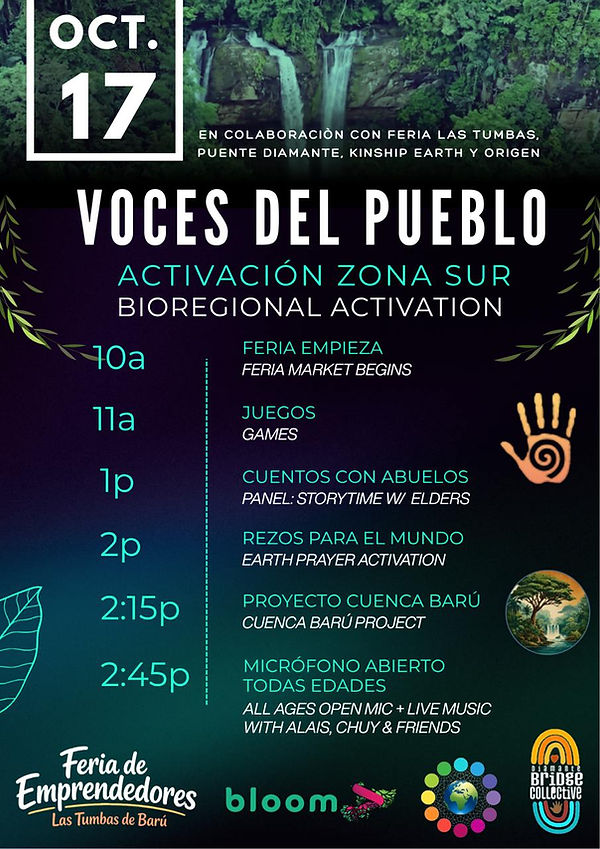
@ the Campo de Fútbol - Salón comunal, Las Tumbas. Costa Rica
What is a Bioregion?
A bioregion (biogeographic region) is a geographical area defined by its natural boundaries, such as watersheds, ecosystems, and climate, rather than political borders. It encompasses interconnected landscapes, species, and ecological processes that support life in a unique way. Key features are:
-
Ecosystem-Based – Includes forests, rivers, mountains, wetlands, and coastal areas that share common ecological characteristics.
-
Watershed-Oriented – Defined by natural water flows rather than artificial boundaries.
-
Cultural & Indigenous Significance – Often aligns with historical human settlements and traditional land stewardship.
-
Self-Sustaining Systems – Supports biodiversity, food systems, and natural cycles (e.g., rainfall, soil regeneration).
What are the bioregions in our area?
-
Osa Peninsula Bioregion (Corcovado rainforest, mangroves, and marine ecosystems)
-
Talamanca Highlands Bioregion (Cloud forests, páramo, indigenous Bribri & Cabécar lands)
-
Golfo Dulce Bioregion (One of the world’s only tropical fjords, rich in marine biodiversity)
-
Central-South Pacific Transition Bioregion (Coastal rainforests, mangroves, and tourism-based ecosystems)
Why Are Bioregions Important?
Bioregions are important because they align conservation and land management with natural ecosystems, ensuring ecological health, climate resilience, and sustainable resource use while supporting local communities and biodiversity.
-
Conservation Planning – Helps protect ecosystems by working within natural landscapes rather than political boundaries.
-
Regenerative Living – Supports local communities in sustainable land and water management.
-
Climate Resilience – Strengthens ecosystems against climate change by preserving biodiversity and natural resources.
Would you like to know more about the Bioregional movement? Sign up below for more information!
Our Cuenca
Where we are?
A bioregion takes its shape from water, soil and the life they carry, and ours is still finding its name. Our home ground is the Diamante Valley, where streams gather into the Barú and run down to the sea at Dominical. The Savegre flows to the north of us and the great Térraba to the south, and between them forest climbs the southern Pacific slope from ridge to shore. Beyond lies the wider Brunca, named for the Brunca people, reaching to the Osa, Corcovado and the Golfo Dulce.
Where does your water come from, and who shares it with you? Where do you feel the edges of home? Come help us draw this map together.
